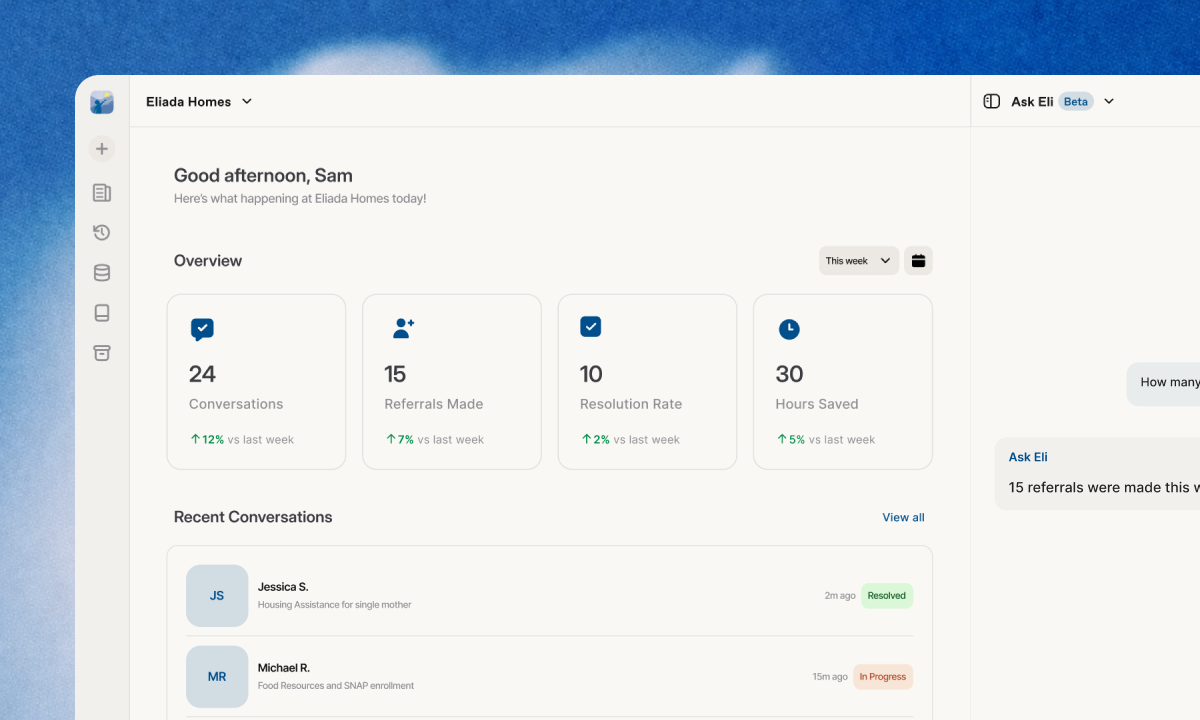
Clearer Operations for Community-Driven TeamsRoleProduct EngineeringSurfacesWebIndustrySocial ImpactContextInternshipThis summer, I spent five weeks in Asheville, North Carolina, as an intern with the Sullivan Foundation’s Service Corps program. My role extended beyond engineering, bringing together consulting, product design, and technical problem-solving to help nonprofits address real challenges.It was my first internship, and much of my first week was spent finding my footing. I was getting familiar with the organization, learning how a multidisciplinary team of interns approached nonprofit consulting, and understanding how ideas were developed, decisions were made, and solutions were presented to clients.Projected 100+ staff hours saved annually for Eliada HomesBuilt a voice-enabled AI assistant and client analytics dashboardConducted client interviews and research on nonprofit AI adoptionRead more The ChallengeNonprofits exist to serve communities, but that mission depends on the systems running behind the scenes. Administrative work can consume time and resources that organizations would rather dedicate to the people they serve.At Eliada Homes, I focused on making organizational knowledge easier to access without adding complexity to existing workflows. The challenge was to understand where AI could be useful and make it practical for the staff using it.How might we make organizational knowledge more accessible while reducing administrative friction for nonprofit staff? Understanding the OrganizationBefore developing anything, I researched nonprofit operations, AI’s potential applications, organizational constraints, and barriers to adoption. Stakeholder conversations helped me understand existing resources and the practical realities of introducing a new tool.This shaped my approach: a solution needed to fit the people doing the work and remain useful beyond development. Defining the DirectionI narrowed the scope to one workflow: helping staff find information through natural-language questions. Three priorities guided the product:Accessibility: Familiar, low-friction ways to ask questionsReliability: Answers grounded in organizational knowledge, with identifiable sourcesVisibility: A way for the organization to understand usage and identify improvements Introducing Ask EliAsk Eli is a voice-enabled knowledge assistant that helps nonprofit staff retrieve internal information. Instead of manually searching documents, staff can ask a question and receive an answer informed by the organization’s knowledge base.I independently led the implementation, spanning product decisions, backend development, interface design, and testing. The prototype uses Python, Gradio, Whisper, GPT-OSS-20B, and a retrieval-augmented generation pipeline. Behind the AnswersA fluent answer is not necessarily a reliable one. I connected the assistant to organizational documents through retrieval-augmented generation: embeddings and semantic retrieval find relevant material before GPT-OSS-20B generates a response. Source citations let staff check the information behind an answer.Staff can submit text or speak a question in Gradio. Whisper transcribes voice input, and request routing handles the question before retrieval and generation. This brought interaction and information access into one connected workflow. Trading Breadth for TrustWhen staff and clients depend on accurate information, answering everything isn't necessarily better. I built Ask Eli around retrieval from organizational knowledge and source-backed responses, prioritizing verifiable information over the flexibility of a general-purpose chatbot. Making Usage VisibleI built an interaction logging pipeline that records usage data in a Hugging Face dataset, then designed a staff-facing analytics dashboard to review usage patterns, recurring questions, and assistant performance.The assistant and dashboard formed two sides of one product: a tool for staff to access knowledge, and a tool for the organization to understand how that capability was being used. TakeawaysEmpathy in ActionOne lesson that stayed with me was putting empathy into action; solutions begin with understanding people and their environments.Learning to Navigate AmbiguityI learned to make decisions without always having a clear roadmap, and to become more comfortable figuring things out along the way.The StoryAs part of the Sullivan Foundation's Service Corps program, I spent five weeks in Asheville, North Carolina, working alongside interns from different disciplines on nonprofit consulting projects. My primary project was with Eliada Homes, where I independently led the research, design, and engineering of an AI-powered solution to improve access to organizational knowledge.The challenge was to make information easier for staff to find without introducing another complicated system into their workflows. I developed Ask Eli, a voice-enabled AI assistant that retrieves information from organizational documents, provides source-backed answers, and helps staff navigate internal knowledge more efficiently.What I ownedEnd-to-end design and development of Ask Eli, from initial discovery to technical architecture.A voice-enabled RAG system built with Python, Whisper, GPT-OSS-20B, and Gradio.A client dashboard for monitoring assistant usage, performance, and recurring questions.Source citations, intelligent request routing, and interaction logging.What I contributedConducted client interviews to identify staff needs.Researched nonprofit AI adoption, examining practical applications, barriers, and opportunities.Presented technical recommendations and project findings to stakeholders.Process01 — Understanding the problemBefore writing code, I needed to understand the people I was designing for. I started by speaking with the client, examining existing workflows, and identifying where information retrieval created unnecessary friction. These conversations helped me narrow the scope of the project and define what a useful solution would look like.02 — Designing and building Ask EliI translated my findings into a working AI assistant, building a retrieval-augmented generation system that could answer questions using organizational knowledge. I incorporated voice input, source citations, and intelligent request routing to make the experience more accessible and reliable.03 — Testing and measuring impactAfter developing the prototype, I gathered client feedback and refined the experience. I also designed and built an analytics dashboard to give the client visibility into assistant usage and performance. The final solution was projected to save over 100 staff hours annually.I'm incredibly grateful to Greg Van Kirk and Luke Lingle, my supervisors at the Sullivan Foundation, for their guidance, encouragement, and trust throughout the summer. Thank you for giving me the space to explore new ideas, take ownership of my work, and grow beyond what I thought I was capable of.A special thank you to Steve McDavid and his wife, Rosie, for their warmth, generosity, and for making Asheville feel like home.And of course, to the wonderful group of interns I had the privilege of spending five weeks with. You made my first internship experience all the more memorable.I came into the summer with a fairly narrow understanding of what it meant to be an engineer. I left with a much broader appreciation for how technology, design, and human connection can come together to create meaningful change, and an even greater curiosity about what I could build next.